
DOUBLE MASONRY


1. Masonry insulation
2. Wooden reinforcement wedge
3. Self-adhesive waterproofing tape
4. Corner connection insulating material
5. Metal tightening cord
6. Self-adhesive Finnish masonry
7. Asphalt membrane
8. Metal compaction angle
1. Masonry insulation
It is placed between the two parts of the double masonry, vertically increasing the thermal conductivity index. It can be either expanded polystyrene or mineral wool, depending on the customer's choice.
2. Wooden reinforcement wedge
It works as a link between the logs but also as reinforcement. It consists of wood of the same quality as the masonry. It further strengthens the construction for greater resistance to stress from horizontal loads.
3. Self-adhesive waterproofing tape
Its double application to each log separately, further strengthens the tightness of the construction and offers absolute insulation to your new home.
4. Corner connection insulating material
Insulating material is applied to the corner joints of the logs, which offers optimal thermal insulation and tightness in the construction, improving the thermal behavior of the house.
5. Metal tightening cord
Metal galvanized screws that are screwed into the masonry and strengthen it due to their mechanical properties and strength. They offer an improved joint in the masonry by increasing the clamping between the logs.
6. Self-adhesive Finnish masonry
We use exclusively Finnish non-glued wood that does not crack and exhibits increased fire resistance compared to conventional wood. It has ideal moisture content (12%-14%) due to dryer treatment. It is the optimal solution for the construction of the new residence.
7. Asphalt membrane
These are waterproofing sheets that are placed at the base of every wooden wall. They protect the trunks from damage that could be caused by moisture on the support base.
8. Metal compaction angle
With these metal corners, the construction is perfectly connected to the reinforced concrete base. In this way, we have a "bonded" construction with increased mechanical strength and improved anti-seismic behavior.

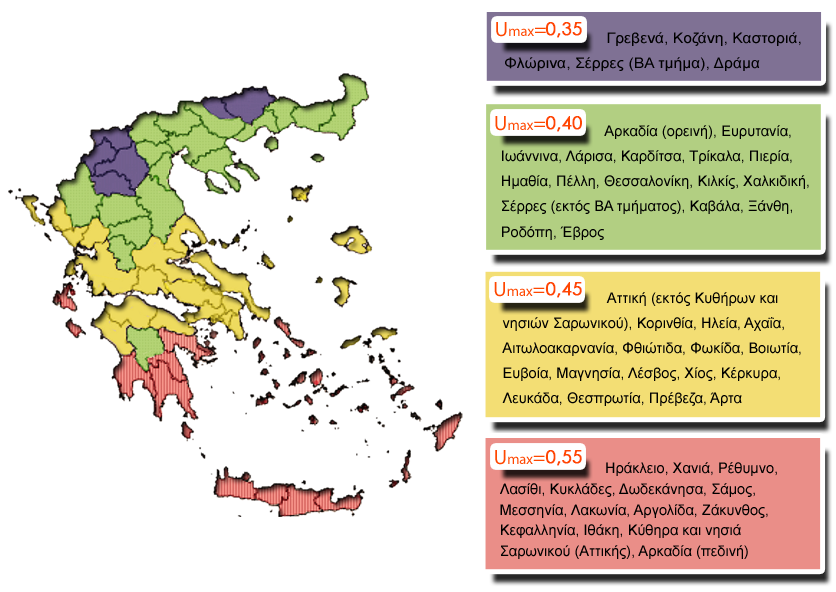
MAXIMUM PERMITTED THERMAL PERFORMANCE COEFFICIENT U OF MASONRY BY CLIMATE ZONE
(as much as smaller the U number of your climate zone (region), both bigger the insulation needed)
 Greek
Greek  English (United States)
  French
  Arabic
  Russian
  Czech
Czech  Bulgarian
  Hebrew
  Swedish
  Finnish
  German
  Italian
  Chinese
  Spanish
  English (New Zealand)